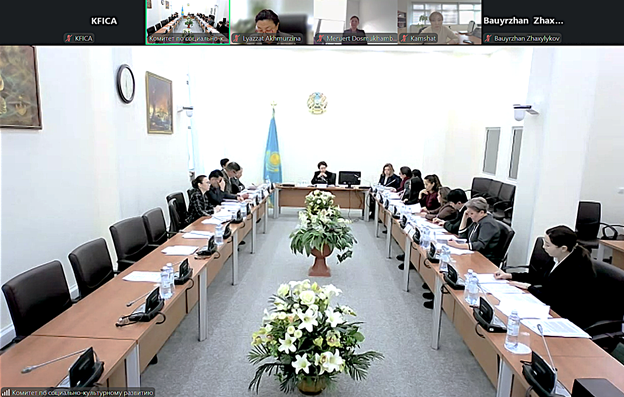
A
meeting chaired by Ms. Daniya Madiyevna Yesspayeva, Deputy Chairperson of
the Mazhilis of the Parliament of the Republic of Kazakhstan, was held to
discuss issues related to the work schedule of rotational workers.
On 20 January 2026, within the framework of the Energy, Ecology and Oil
& Gas Industry Working Group of the Foreign Investors’ Council under the
President of the Republic of Kazakhstan, a working meeting took place at the Mazhilis
of the Parliament of the Republic of Kazakhstan, in a hybrid format (online and
offline). The meeting was chaired by the Deputy Chairperson of the Mazhilis,
Ms. Daniya M. Yesspayeva, and focused on aspects of rotational work
regulations.
From
the Mazhilis of the Parliament of the Republic of Kazakhstan, the meeting was
attended by:
·
Askhаt K. Aimaghambetov, Chair of the Committee on Social and Cultural Development
·
Adil O. Zhubanov, Member of the Committee on Finance and Budget
·
Kudaibergen Beksultanov, Member of the Committee on Social and
Cultural Development
Representatives
of the Ministry of Labour and Social Protection of the Population of the
Republic of Kazakhstan included:
·
Askarbek M. Yertayev, First Vice Minister of Labour and Social Protection
·
Zhuldyz Zh. Abulgazina, Director of the Department of Labour and Social Partnership
The
foreign side was represented by:
·
Cécile Rauline, Managing Director of ExxonMobil Kazakhstan Inc. and Co-Chair of the
FIC Working Group on Energy, Environment and the Oil & Gas Industry from
foreign side,
·
as
well as representatives of Tengizchevroil (TCO), ExxonMobil
Kazakhstan Inc., and NCOC.
Representing
the National Chamber of Entrepreneurs of the Republic of Kazakhstan “Atameken”:
·
Gulnara K. Bizhanova, Member of the Board of the National Chamber of Entrepreneurs
“Atameken”
Representatives of
the KAZENERGY Association (via online):
·
Lyazzat Zheksenbayevna Akhmurzina – Executive Director of the KAZENERGY
Association
During
the meeting, participants discussed statistics on the application of 14/14,
21/21, and 28/28 rotational schedules, as well as working conditions
for employees of operator and service companies. The need for clearer
regulation of the procedure for obtaining employee consent for rotational
work and for strengthening worker protection mechanisms was
emphasized.
Business
and investor representatives highlighted the importance of a flexible approach
to rotational work scheduling, taking into account production
specifics and providing employees with options to choose rotational
schedules where possible. Attention was also drawn to the particular
challenges faced by workers commuting from other regions, including additional
transportation risks and costs.
Government
representatives noted that the Government’s official position on this issue is
currently under coordination. At the same time, emphasis was placed on
maintaining a balance between protecting workers’ rights and addressing the
operational needs of various sectors of the economy.
Following
the meeting, participants expressed a shared understanding that further
discussions would focus on strengthening legal provisions governing employee
consent for rotational work, as well as considering the 21/21
rotational schedule as a potential compromise option. Final decisions
will be made taking into account the Government’s conclusion and the positions
of all stakeholders.