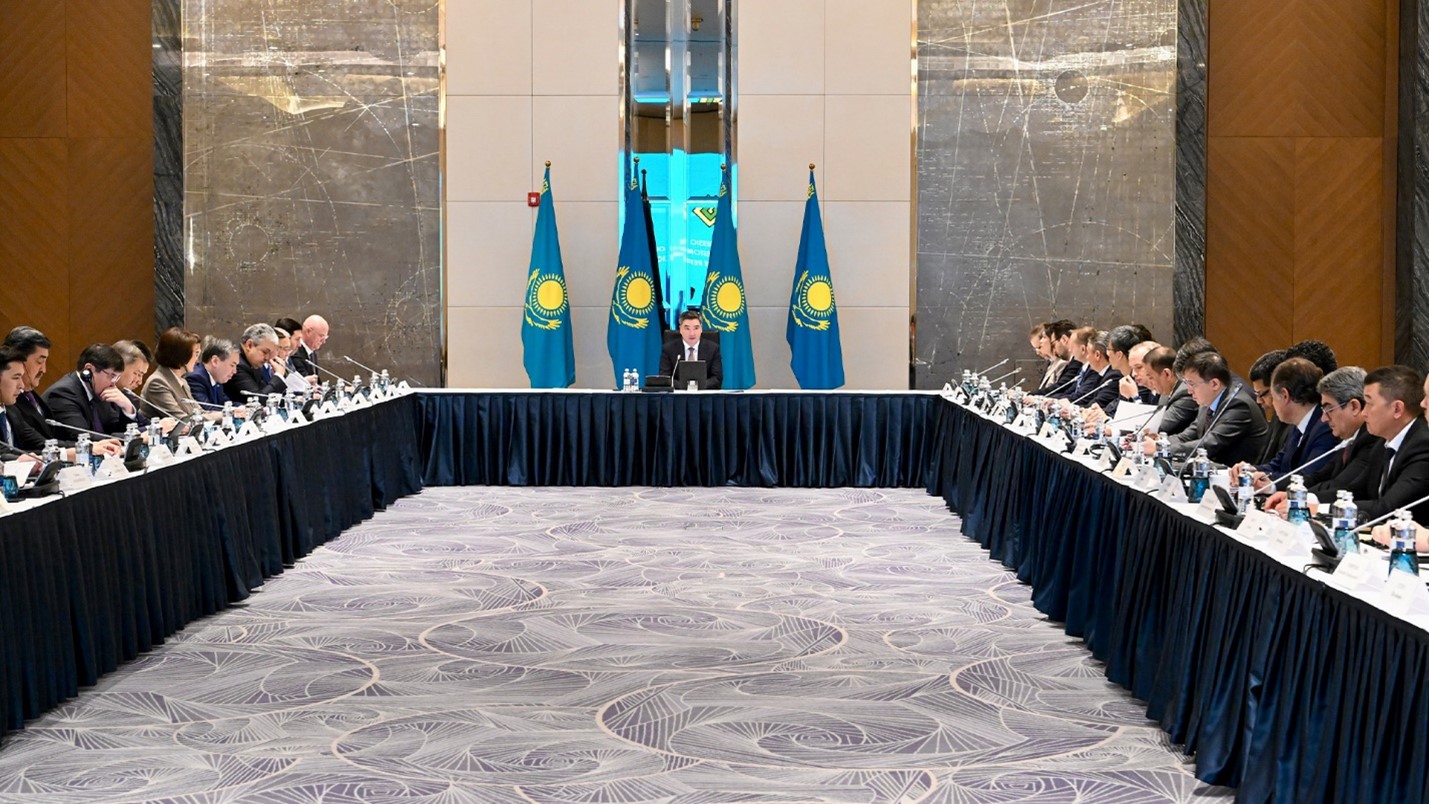
Prime
Minister Olzhas Bektenov held an interim meeting of the Council of Foreign
Investors under the President of the Republic of Kazakhstan. The meeting
addressed issues of investor support and the joint development in Kazakhstan of
next-generation high-tech production with wide application of artificial
intelligence and digital solutions.
By instruction
of the Head of State, the Government is implementing a proactive investment
policy. The development of artificial intelligence and digital transformation
has been identified as a national priority. To achieve these objectives, an
institutional architecture has been established: a Presidential Council for AI
Development with the participation of international experts has been created,
and a Digital Headquarters is operating. To strengthen the digital cluster, the
international AI center Alem.ai has been launched; infrastructure projects are
being implemented in parallel, including the Data Center Valley, as well as the
Astana Hub ecosystem. To scale technology projects, a venture capital fund has
been launched as a startup accelerator. Unicorn companies with valuations
exceeding USD 1 billion have already entered the Kazakhstani market, including
Playrix, Mytona, and NetCracker.
“The
strategy implemented in line with the President’s directives is aimed at
accelerated development of the digital sector and increasing IT services
exports to USD 1.2 billion this year. Overall, digital transformation and AI
development are key elements of sustainable economic growth, improved public
administration efficiency, and quality of life. At the same time, the
Government is open to constructive dialogue with investors across all sectors
and is ready to jointly find solutions that contribute to your success and the
development of our country,” Olzhas
Bektenov said in his address to participants.
The Prime
Minister reviewed the outcomes of implementing instructions following the 37th
plenary meeting of the Council. In 2025, to enhance Kazakhstan’s investment
attractiveness, new rules for issuing investor visas were approved. A “golden
visa” was introduced, providing a residence permit of up to 10 years for
foreign nationals. Deputy Minister of Foreign Affairs Alibek Kuantyrov reported
that measures are being taken to regulate the use of certified cloud services
with due regard to national security requirements. In connection with
amendments to the Tax Code, meetings were held with Council members to explain
the new provisions and discuss current issues raised by foreign participants.
Deputy Prime
Minister and Minister of Artificial Intelligence and Digital Development
Zhaslan Madiev reported on preparations for the 38th plenary meeting of the
Council. Kazakhstan has established a legal and technological foundation for a
digital nation: President Kasym-Jomart Tokayev has signed the Digital Code;
AI-based solutions are being consistently implemented; domestic large language
models and public digital services are being developed. Focus areas include
human capital development and strengthening the digital cluster.
The meeting
heard reports from joint working groups on investment policy implementation;
energy, environment, and the oil and gas sector; labor legislation, human
capital development, and attraction of foreign labor; digitalization;
healthcare and pharmaceutical industry development. Issues discussed included
customs valuation and VAT neutrality, regulation of methane emissions in the
oil and gas sector in line with international practice, proposals on visa
support for foreign labor, and mentorship programs. Regarding regulation of
public cloud services, the need to balance innovation and security was noted.
In healthcare, the importance of public-private partnerships in professional
training, internships, and dual education programs was emphasized.
Senior officials
from the ministries of national economy, energy, labor and social protection,
artificial intelligence and digital development, and healthcare provided
comments on the issues raised by investors.
Special
attention was given to the implementation of digital solutions in the energy
sector. High efficiency was noted in the successful use of AI-based
defectoscopy of overhead power lines. Within a pilot project, 618 power line
towers were inspected over two days, more than 2,000 images processed, and nearly
7,000 defects identified. Recognition accuracy for typical damage reached 98
percent, including insulator contamination and destruction, tower deformations,
missing fasteners, and line break risks. The introduction of thermal imaging
and LiDAR systems further enhanced digitalization, enabling comprehensive
diagnostics. In parallel, robotic in-pipe diagnostics based on acoustic
resonance are being implemented in heating networks, allowing internal
inspection without pipe excavation and enabling targeted repairs. A pilot
project in Shymkent in 2025 demonstrated savings of over 70 percent when
inspecting 1.2 kilometers of heating networks. In the gas sector, an AI
assistant has been introduced for automatic recognition of gas meter readings
from photographs in a mobile application, proving effective in reducing
operator workload and minimizing human-error risks.
A wide range of
issues was discussed during an open dialogue with foreign investors.
Marubeni
expressed interest in the participation of Japanese companies in AI and digital
technologies, including their application to support socially vulnerable
groups. The Ministry of Artificial Intelligence and Digital Development cited
practical AI use cases based on the Digital Family Map within Smart Data Ukimet
and highlighted the development of the Social Wallet.
Polpharma raised
issues of patient safety and combating counterfeit medicines. The Ministry of
Healthcare reported on the introduction of mandatory drug labeling from July 1,
2024, and plans to implement a risk-based mechanism for selecting medicines
from the market.
Companies
including CNPC, EY, JP Morgan, and Kazzinc also raised issues related to oil
transportation tariffs, modernization of data localization and cross-border
transfer requirements, taxation in the mining and metallurgical complex, and
other matters.
Following the
meeting, the Prime Minister instructed state bodies and organizations, together
with the Association “Kazakhstan Council of Foreign Investors,” to elaborate on
all issues and recommendations raised.